
Automatic Particle Counter (APC) Analysis
ISO 11171 (Hydraulic fluid power — Calibration of automatic particle counters for liquids) governs the calibration of Automatic Particle Counters (APCs) used with hydraulic and other petroleum-based fluids — including aviation and diesel fuels and engine oil. An instrument that senses, sizes, and counts particles using optical light-extinction or light-scattering principles only becomes a true APC once it has been calibrated according to ISO 11171, using certified test dust suspensions to verify its particle sizing and counting accuracy. That calibration — not the underlying sensing technology — is what qualifies an instrument as a true APC.
That calibration matters because the cleanliness codes the hydraulic industry relies on are built directly from APC particle counts. ISO 4406 (Hydraulic fluid power — Fluids — Method for coding the level of contamination by solid particles), the most widely used cleanliness coding system for hydraulic fluids, and AS4059 (Aerospace Fluid Power — Cleanliness Classification for Hydraulic Fluids), commonly specified for aerospace and defense systems, both convert an APC’s particle counts into a standardized cleanliness code. Without a consistent, ISO 11171-calibrated instrument behind those counts, the same fluid sample could report differently from one lab or instrument to the next — undermining the comparability these codes exist to provide.
Applications
APC analysis, coded to ISO 4406 or AS4059, is typically run on:
• Hydraulic fluid (industrial and mobile equipment)
• Aviation hydraulic fluid (aerospace and defense, per AS4059)
• Lubricating and gear oil
• Turbine oil
Testing can support fluid cleanliness monitoring, flushing verification, filtration studies, and inspection of packaged or incoming stock.

Advantages
- Calibrated to ISO 11171, which is what qualifies an instrument as a true APC
- Fast, objective, repeatable results from a fully automated process
- Automated sample handling gives highly repeatable data, run to run
- Results can be converted into standardized cleanliness codes such as ISO 4406 or AS4059
Considerations
- The sample should be a clear, homogeneous, single-phase liquid, free of macroscopic particles or cloudiness
- Dark, opaque, highly viscous, or heavily contaminated fluids can exceed the sensor’s coincidence limit, and dilution with a compatible liquid may be required to get an accurate count
- Water content: Free or emulsified water in a fluid sample can be detected as particles by a light-extinction sensor, artificially inflating the count and skewing the reported cleanliness code. Samples are screened for water content before analysis, and elevated levels may need to be addressed before or alongside APC testing
Sample Requirements
Liquid samples should be clear, homogeneous, and single-phase, submitted in clean, contamination-free containers, and filled to no more than ~80% of the sample bottle’s capacity. Approximately 100–250 mL is generally sufficient for routine APC analysis, and samples may be diluted if too viscous, optically dense, or above the counter’s coincidence limit.
Detection Range
The PAMAS SBSS detects particles from 1 to 200 microns and is calibrated per ISO 11171.
Data Reported
An ISO 4406 three-number code (4/6/14 micron channels) and/or an AS4059 class, counted directly by the APC — along with a comprehensive summary including graphical histograms of cumulative and differential particle size distributions and particle counts by user-defined size range.
Sample Reports
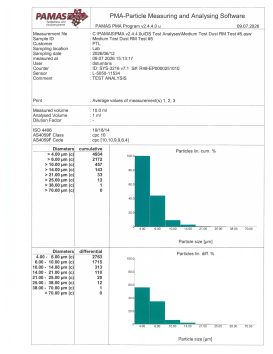
Instrumentation
APC instruments are available from a number of manufacturers. Particle Technology Labs performs APC analysis using the PAMAS SBSS Laboratory Particle Counter.